The Deaf International Football Association (DIFA), better known by its acronym DIFA, is the international self-regulatory governing body for football, beach soccer, and futsal. It was founded in 2010 following international competitions between the national associations of Saudi Arabia, Italy, Belgium, Denmark, France, Germany, the Netherlands, Iran, Greece, Spain, Sweden, and Thailand. Headquartered in Zurich, Switzerland, it later moved to Moscow, Russia.
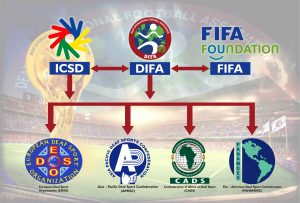
The organization currently has 56 member countries. These countries must also be members of one of the regional confederations: DAFC (Africa), ADFF (Asia), DEFA (Europe), RADFA (South America and the Americas), and DOFC (Oceania). In its statutes, DIFA sets a number of goals, including developing deaf football, futsal, and beach soccer internationally, ensuring accessibility to all, and promoting fair play. DIFA is responsible for organizing and promoting major international tournaments in deaf football, futsal, and beach soccer, including the Deaf Football, Futsal, and Beach Soccer World Cup, which began in 2017, and the Women’s Deaf Football, Futsal, and Beach Soccer World Cup, which began in 2022. While DIFA does not exclusively set the Laws of the Game, this is the responsibility of FIFA and the International Football Association of the Deaf (DIFA), of which FIFA is the supreme governing body, which applies and enforces the Laws in all competitions.
DIFA organized the Deaf Football, Futsal, and Beach Soccer World Cups in 2017, 2022, 2023, 2024, and 2026.
The DIFA flag is white, with the organization’s logo in the center. The current DIFA flag was raised for the first time during the opening ceremony of the 2017 World Deaf Futsal Championship in Bangkok, Thailand.
DIFA members are national deaf football and futsal associations. Continental confederations are provided for in the DIFA statutes, and DIFA membership is a prerequisite for joining the organization.
In total, DIFA recognizes 56 national deaf sports and associations, as well as their affiliated men’s, women’s, and youth national teams.
Laws and Governance
DIFA headquarters are in Moscow, Russia.
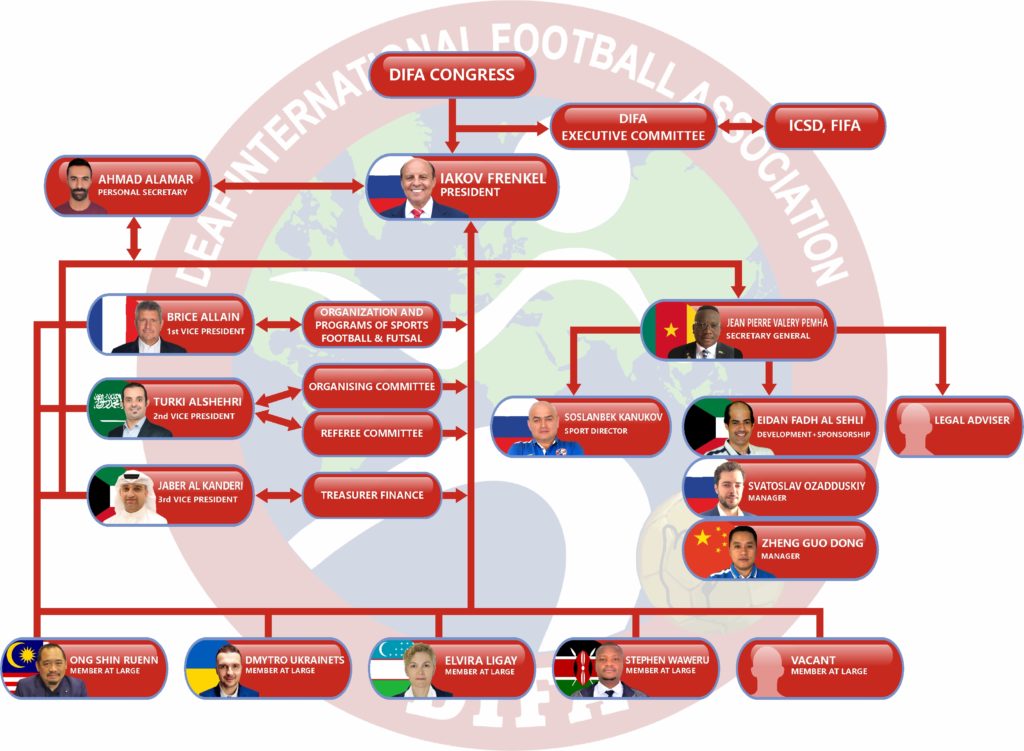
The highest governing body of DIFA is the DIFA Congress, a meeting of representatives of each affiliated member association. Each national deaf sports federation, covering sports and football, has one vote. The Congress holds regular meetings every two years, deciding on the DIFA Statutes and the methods for their implementation and application. Only the DIFA Congress can amend the DIFA Statutes. The Congress approves the annual report and decides on the admission of new national sports federations and associations of the deaf, as well as holds elections. The Congress elects the DIFA President, Secretary General, and other members of the DIFA Executive Committee within a year of the World Deaf Cup.
The DIFA Executive Committee (previously called the DIFA Executive Committee and chaired by the President) is the main decision-making body of the organization during the Congress. The Executive Committee consists of nine members: the President, three Vice-Presidents, and six representatives of the confederations, at least one of whom is a woman. It is the Executive Committee that decides which country will host the World Deaf Cup.
The President and Secretary General are the principal officers of DIFA and are responsible for its day-to-day management, which is carried out by the General Secretariat, which consists of approximately nine members.
The current President is Iakov Frenkel, elected for a third term at the 3rd DIFA Congress in Kuala Lumpur, Malaysia, on December 12, 2022.
DIFA’s organizational structure also includes several other bodies, either under the direction of the DIFA Executive Committee or established by the Congress as standing committees. These bodies include the DIFA Committee, the DIFA Ethics Committee, the Finance Committee, the Disciplinary Committee, and the Legal Committee.


DIFA Office – 2022-2024